The series.
What it is and what it refuses to be.
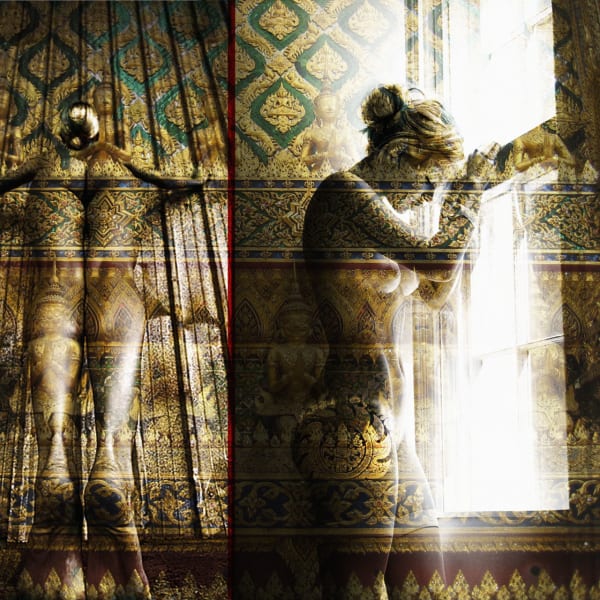
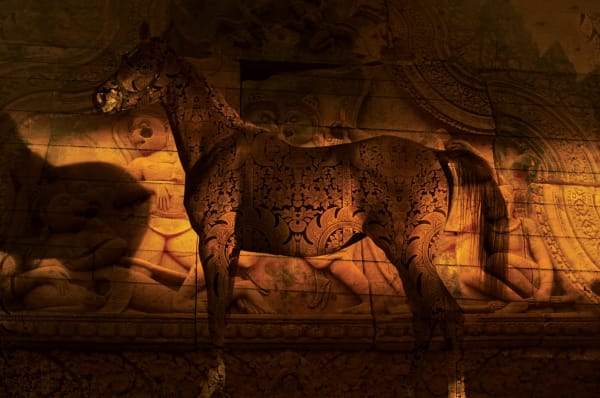
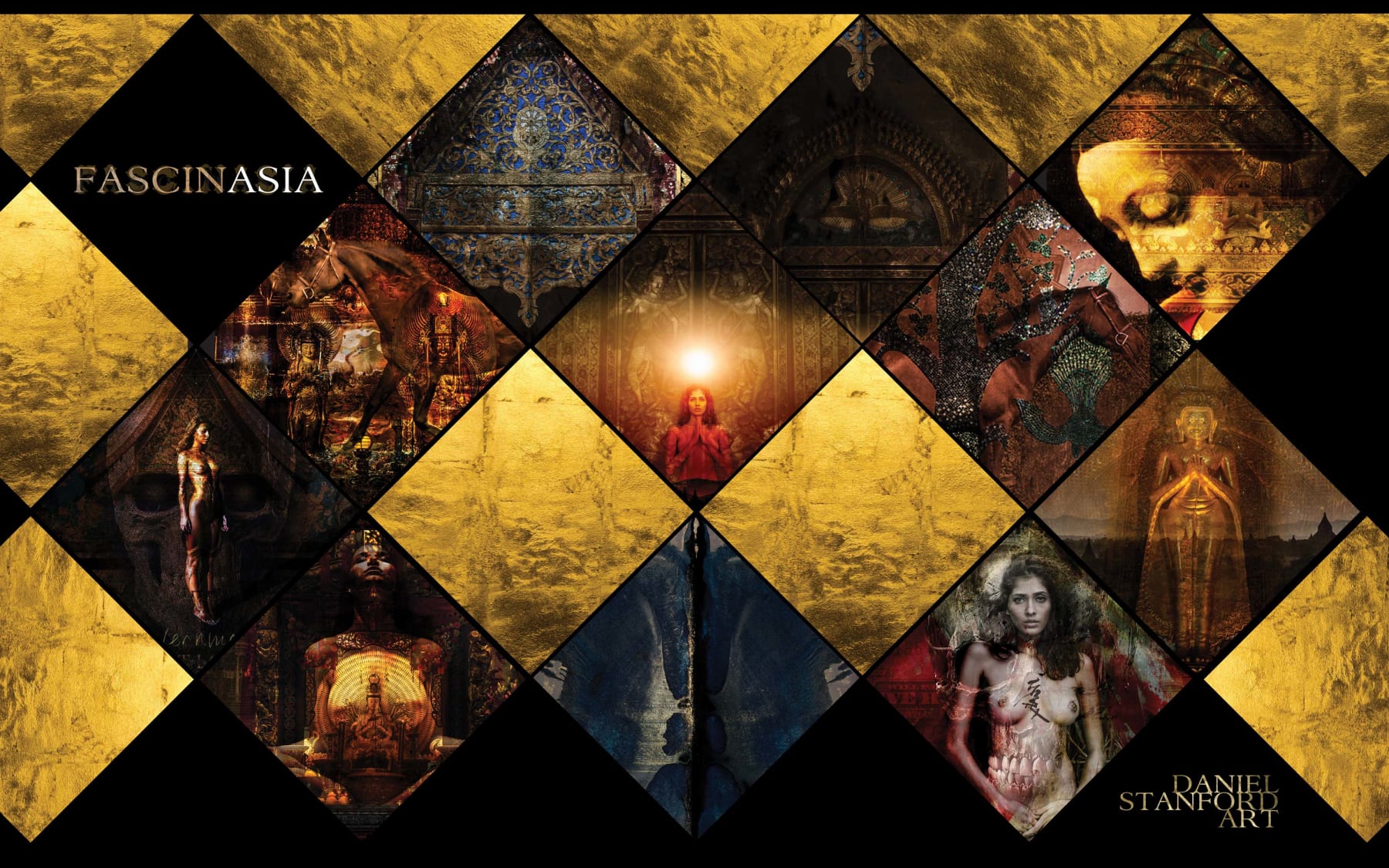
FASCINASIA is Daniel Stanford's primary fine art painting practice — a series of mixed-media works that occupy the territory between haute photography and painterly gesture. The works are built on photographic foundations and extended through paint, texture, and material intervention until the photograph beneath is no longer visible as source. What remains is something that has the warmth of a painting and the precision of a lens — two registers that fine art usually keeps separate.
The series title is a compound Stanford coined from fascination and Asia — a reference not to geography but to a certain quality of the Orientalist sublime: images that draw the eye into depth, that refuse resolution, that maintain their strangeness no matter how long you look. The works are not decorative in the sense that hospitality art is decorative. They are demanding. They ask something of the room they inhabit and something of the person standing in front of them.

"The investment thesis is simple: 50 works, institutional scorer, artist with a 25-year body of work behind it. The half-point I am withholding is not doubt — it is patience."
— Marie-Christine Gilbert PhD · Index Contributor · National Gallery of Canada
Why an outside scorer.
And why this one.
MODUS introduced an independent scoring system — the MODUS Index — precisely to remove the conflict of interest that compromises most art publication coverage. When a magazine publishes art, it is either advertising, or it is the editor reviewing their own taste. Neither is useful to a serious collector or a cultural institution making acquisition decisions. The MODUS Index assigns domain authorities — specialists with institutional standing — to score work in their field. The artist does not score their own work. The editor does not score the artist he publishes.
For FASCINASIA, MODUS appointed Marie-Christine Gilbert, PhD, as Index Contributor for fine art. Her affiliation is The National Gallery of Canada — an institution that has assessed thousands of works for acquisition, permanent collection, and cultural significance. Her score carries weight that no editor's endorsement can manufacture. It is an assessment, not a promotion.
MODUS Index · Scored by
Marie-Christine Gilbert, PhD
Index Contributor — Fine Art · The National Gallery of Canada
"FASCINASIA operates at the register where painting stops trying to represent and starts trying to seduce. The investment thesis is simple: 50 works, institutional scorer, artist with a 25-year body of work behind it. The half-point I am withholding on Investment Value is not doubt — it is patience. The series is not yet fully absorbed by the institutional market. That absorption is a matter of time, not merit."
— Marie-Christine Gilbert, PhD · Index Contributor — Fine Art · The National Gallery of Canada · MODUS Issue No. 1
Institutional Endorsement · MIS São Paulo
Cleber Papa
Cultural Director · Museu da Imagem e do Som · São Paulo, Brazil
Following the group exhibition of FASCINASIA and the Exchanging Glances series at the MIS — Museu da Imagem e do Som, São Paulo, Cultural Director Cleber Papa extended a Solo Exhibition invitation to Daniel Stanford. The invitation, made in 2019, represents the highest form of institutional recognition available from one of Brazil's foremost cultural institutions. The show is ongoing.
"Solo exhibition invited by the Museum of Image and Sound (MIS), São Paulo — Cultural Director Cleber Papa, 2019. Ongoing."
— Cleber Papa · Cultural Director · MIS São Paulo · 2019

The 10/10.
Why Sensory Truth is the axis that matters.
The MODUS Index scores on five axes. Four of them — Rarity, Craft, Investment Value, Timelessness — are assessable through documentation, market data, and comparative analysis. Sensory Truth is different. It is the axis that requires presence. It asks whether the work does what it claims to do when you stand in front of it — the experience it promises is delivered, whether it generates the specific quality of attention it was built to generate.
Gilbert scores FASCINASIA 10/10 on Sensory Truth. That is the highest score in this axis across every work reviewed in Issue No. 1. It is not a common score — Gilbert has seen thousands of works through the National Gallery's assessment process, and a 10/10 on Sensory Truth is reserved for work that does something irreducible in person. FASCINASIA delivers disorientation as its core promise. According to the Index Contributor who scored it, that promise is kept completely.