"Launch control engages. The flat-six climbs past seven thousand. At nine thousand you are no longer thinking about the car — you are the car. I drove the 911 twice. I remember both. This is about what the 911 S/T is, what it means, and what the new 2026 GT3 S/C adds to the argument."
— Daniel Stanford · Editor-in-Chief · MODUS · First-hand testimony
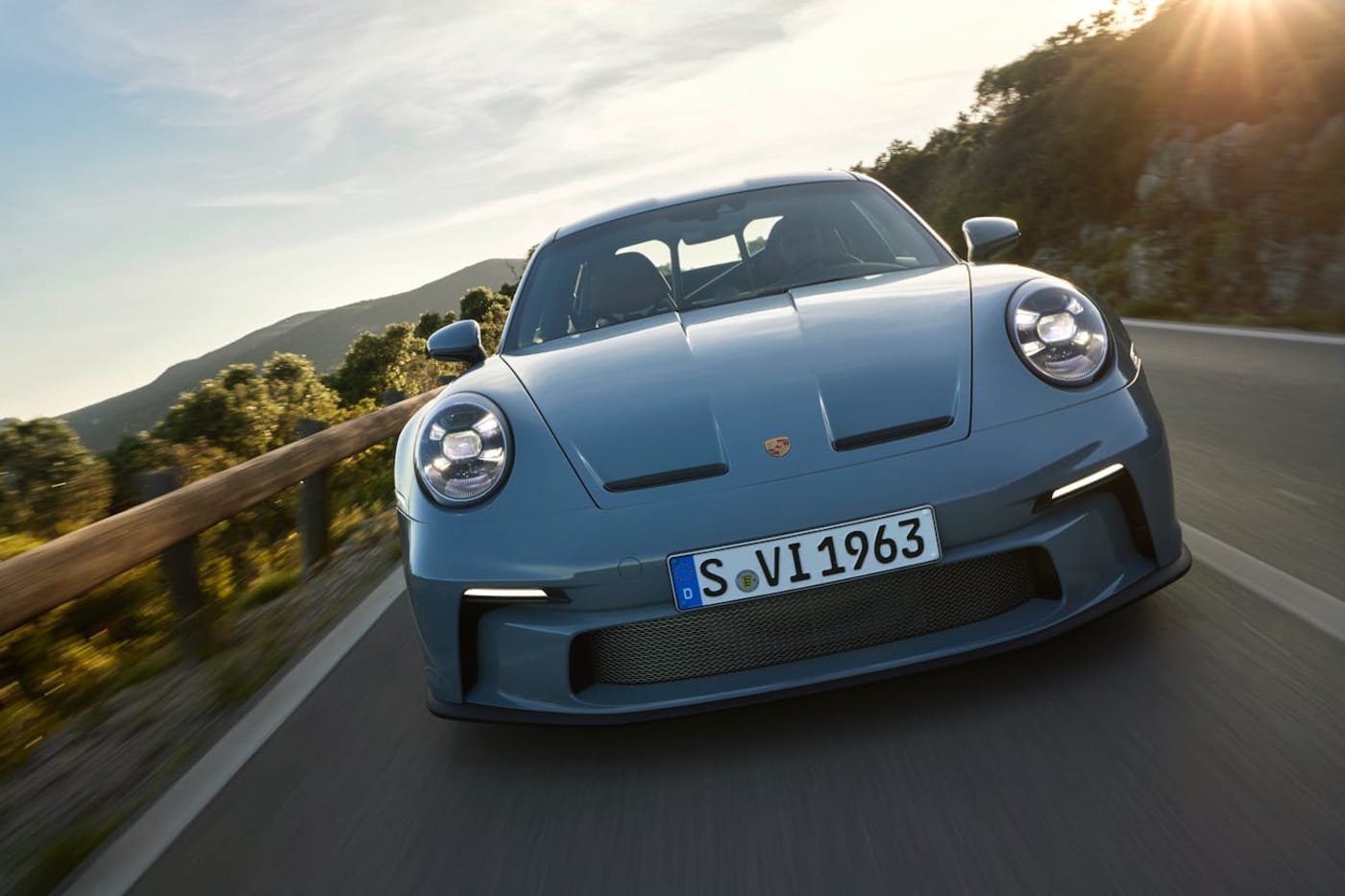
Porsche 911 S/T.
The reference.
992 Generation · 2024 · 1,963 units · Manual only · MODUS Index 48 / 50
In 1963 Porsche built the first 911. In 2024, to mark sixty years, they built the last best version of it: the 911 S/T. 1,963 units. That number is not coincidence. It is a sentence — and the full stop is a six-speed manual gearbox offered without alternative. You want a PDK? Buy something else. Porsche is not interested in your preference for comfort here.
The car combines the GT3 RS's 518-horsepower naturally aspirated flat-six with the Touring's visual restraint: no fixed rear wing, carbon roof, fenders, doors, bonnet. At 3,056 pounds it is the lightest 992-generation 911 Porsche has made. The Heritage Design Package — with its racing number circles, period PORSCHE script, and chalk blue or black paint — makes explicit the conversation the car is having with its own history. The number 63 on the door is not decoration. It is a date.
"Launch mode is extremely memorable. And the standard shift is so fun to drive. A real driver's car. That is what I remember — not just the speed. The engagement. The fact that the car requires something from you and gives something back that is not available any other way."
Daniel Stanford — Direct testimony · Porsche 911 GT3 driven
On the manual. Why it still needs saying.
Every conversation about manual transmissions reaches the same false conclusion: the automatic is objectively faster, therefore the manual is sentiment. This is correct and entirely beside the point. The six-speed in the 911 S/T is not there to go fast. It is there because the act of driving — the heel-and-toe on a downshift, the exact weight of the clutch at the biting point, the short throw of the gate — is the product. Speed is a byproduct. If you need this explained, the S/T is not for you, and your purchase will be wasted even at the original $291,650, let alone the million dollars the secondary market now asks.
The market is asking a million dollars. Market examples now trade between $430,000 and over $1,000,000. This is collective madness, and it is also correct. The S/T is the finest road-going 992 Porsche ever built. It will not be made again. The 1,963-unit limit, the manual-only mandate, the carbon construction, the GT3 RS engine in a Touring body — this combination of factors will not recur. What the market is doing is pricing scarcity correctly, which is not the same as the car being worth a million dollars to drive. It is the car being irreplaceable to own.
MODUS scores the S/T 48 out of 50.
Timelessness: 10. The 911 silhouette has not fundamentally changed since 1963. The S/T's hardtop, its unbroken roofline from A-pillar to engine cover, is as resolved an automotive object as exists in production. Material Integrity: 10. Carbon fibre, aluminium, leather — nothing here is there for cost reasons. Aesthetic Authority: 10. It announces its nature without explanation. Investment Value: 10. The secondary market has already spoken. Spatial Versatility: 8. The S/T is not a daily car. It is a weapon built for a specific condition. The two points deducted are not a criticism. They are honest. The Index records constraints.
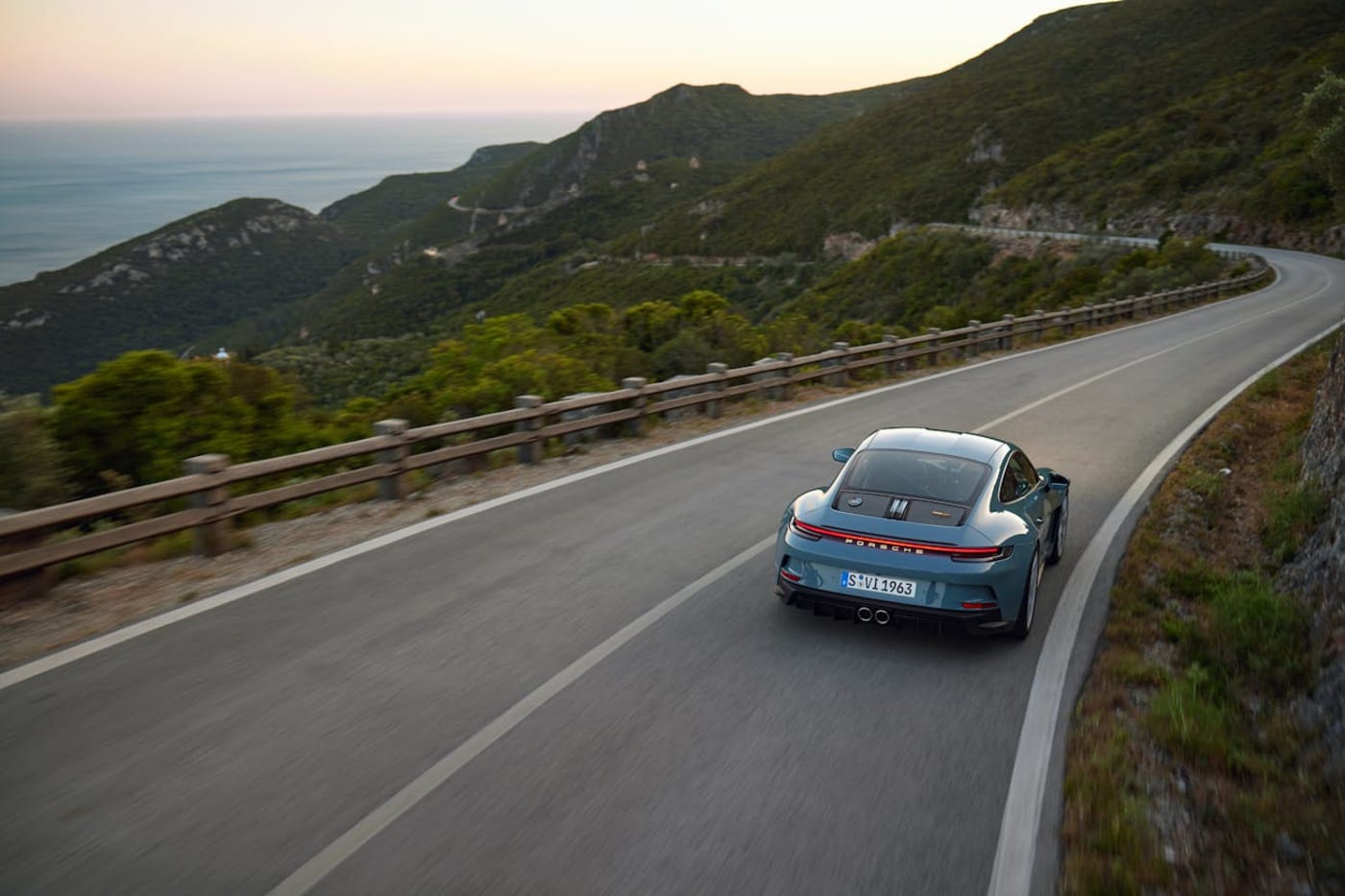
Porsche 911 GT3 S/C.
The answer.
World Premiere · April 14, 2026 · Convertible · First open-air GT3 · MODUS Index 46 / 50

Porsche has answered a question nobody asked and gotten the answer exactly right. The 911 GT3 S/C, revealed at world premiere on April 14, 2026, takes the S/T's philosophy — lightweight, manually driven, high-revving, uncompromising — and removes the roof. This should not work. Cabriolets are for the boulevard. GT3s are for Weissach. The S/C insists on being both simultaneously, and the argument is persuasive.
The engine is the same 4.0-litre naturally aspirated flat-six as the S/T — 9,000 rpm ceiling, specific oil coolers, aggressive cams from the GT3 RS, flow-optimised throttle bodies. The six-speed manual is the only gearbox. Carbon fibre doors, fenders, bonnet, anti-roll bars, and shear plate from the S/T all carry over. At 1,497 kg it is only approximately 30 kg heavier than the 991-generation 911 Speedster — a genuine engineering achievement given it now carries a fully automatic hood mechanism that opens and closes in 12 seconds at speeds to 50 km/h.
The detail that tells the whole story.
The digital tachometer can be rotated so that the 9,000 rpm limit sits at 12 o'clock. This is not a gimmick. It is a declaration of intent about what the instrument is for, and about who this car is built for. The person who understands this immediately — without needing it explained — is the person Porsche built the S/C for. The badge on the door reads GT3 S/C in script. Gold centre-lock wheels are available alongside Pyro Red. The soft top opens in 12 seconds. The engine note does not require a roof. At nine thousand rpm with the sky above you, the case for this car is made physically before the mind has finished forming an opinion.

What the S/T still does that the S/C cannot.
The MODUS Index gives the S/T 48/50 and the S/C 46/50. Two points separate them, and those two points are not a verdict on quality — both cars are flawless by any rational measure. They are a verdict on architectural resolution. The S/T is a hardtop. Its roofline from A-pillar to engine cover is continuous and unbroken. The car reads as a single resolved object from every angle. The S/C introduces a hood stack and a convertible mechanism that, however lightweight, creates visual interruption at the rear. The S/T has the aesthetic authority of a closed proposition. The S/C has the sensory authority of an open one. These are different claims. Both are legitimate. The Index records both honestly.
Official World Premiere Film — April 2026
Porsche 911 GT3 S/C — World Premiere
Official film · Porsche Newsroom · April 14, 2026
Watch on Porsche Newsroom ↗
GT3 S/C Press Gallery · 2026


All images: © Porsche AG / Porsche Newsroom. Used under editorial terms for journalistic reporting. Source: newsroom.porsche.com — MODUS Magazine, Stanford Emporium Inc., Montreal. Editor-in-Chief: Daniel Stanford.
S/T vs GT3 S/C — The MODUS Index verdict
| Axis | 911 S/T · 2024 | GT3 S/C · 2026 | Edge |
|---|---|---|---|
| Timelessness | 10 | 9 | S/T |
| Material Integrity | 10 | 10 | Equal |
| Aesthetic Authority | 10 | 9 | S/T |
| Spatial Versatility | 8 | 9 | S/C |
| Investment Value | 10 | 9 | S/T |
| MODUS Total | 48 / 50 | 46 / 50 | S/T |
| For the collector | S/T | — | S/T |
| For the driver | — | S/C | S/C |
| Sensory peak | Launch at 9K rpm closed | 9K rpm open air | S/C |
The S/T is the greater object. Its hardtop architecture, 1,963-unit scarcity, and uncompromised aesthetic resolution give it a claim on permanence that the S/C, however extraordinary, cannot match on the same terms. The S/C is the greater sensory experience — at 9,000 rpm with the roof open and the flat-six note uncontained by any surface above you, the argument for this configuration is made in the body before the mind has an opinion. These are not competing claims. Choose based on whether you will drive it or own it. If both: the S/T is the record. If driving: the S/C, roof down, manual engaged, is the finest hour available in a production car in 2026.


